 Play now
How to play Higher or Lower
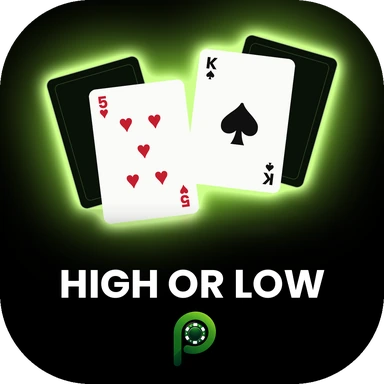
Also called High or Low · Hi-Lo · Higher lower card game · Red or black
2–16 players
One card sits face up. Whoever is up says whether the next one off the deck beats it - higher or lower - and the deck answers straight away. The ace is low - one, the worst card on the table - the king is high, suits count for nothing, and the card just turned becomes the next player's card.
Two cards of the same rank lose, whichever way it was called: the next card had to beat the one on the table and it did not. Play it for chips at even money, or play the drinking game, where a wrong call drinks and takes Truth or Dare if the table has it on.
How to play
One card is face up on the table. Whoever is up says whether the next card off the deck will be higher or lower than it, the card turns over, and the deck settles it. Then the card that just turned becomes the card the next player is calling against, and it goes round.
The ace is low - one, the worst card in the deck - the king is high, and suits count for nothing, so the whole question is the rank. An ace is very nearly a free call and a king very nearly the opposite, which is the game: most turns are easy, and every so often somebody is handed a seven with nowhere good to go.
The table goes round a set number of times and then stops, so the summary at the end is a session rather than an endless run. The player who calls first moves on each round.
Two of the same rank
If the card that turns over is the same rank as the one it is being compared to, the call loses - whichever way it was made. The next card had to beat the one on the table, and a card of the same rank does not beat anything.
It costs exactly what any other wrong call costs: the stake goes, a run of right calls ends, and at a drinking table it drinks. There is no third outcome to remember, which is the point - higher, lower, and a pair is neither.
Playing for chips
Stake before you call. A correct call pays even money - stake a hundred, win a hundred - and a wrong one loses the stake. Staking nothing sits the turn out, which is a real option on a card you would rather not call.
There is no bonus for a long run. A streak is worth bragging rights and nothing else, deliberately: a game that paid more for a longer run would push people into calling cards they should be sitting out.
The drinking game
Nothing is staked and nothing is counted. A correct call is safe, and a wrong one drinks - including a pair, which loses like anything else. That is the whole of it.
Turn on Truth or Dare and a wrong call is also put on the spot: truth or dare, a prompt from whichever books the host has enabled, and the table votes them through when they have done it. One re-draw each if the prompt is unreasonable, and the host can always move it on.
Everyone on one phone
There is no hidden hand in this game - the card everybody is calling against is face up in the middle - so several people can play on one device. Add them at the table and pass it round; the app says whose turn it is and waits to be handed over.
Each of them is a real player: their own name, their own face, their own chips, and their own streak.
The other games
 TongitsThree players, melds and discards. Empty your hand or call it.
 Pusoy (Chinese Poker)Thirteen cards split into three hands, scored row by row.
 Lucky 9Two cards, closest to nine. Ace to ten only, no face cards.
 High Card, and Truth or DareOne card each. Highest wins - or drinks.
 MinesTake turns opening boxes. Hit a mine and you drink - or find the treasure and take the pot.
 King's CupDraw a card, do what it says. The fourth King drinks the cup.
 Most Likely ToEveryone votes on who is most likely to. The most votes gets the card.
 In-BetweenBet whether the third card falls between the first two.
 Texas Hold'emTwo hole cards, five community cards, four betting rounds.
 BlackjackBeat the dealer without going over 21.
 BaccaratBack the Player, the Banker, or a Tie.
 Dragon TigerOne card each side. Back the Dragon, the Tiger, or a tie.